A few years ago I asked whether AI could accelerate a revolution in schooling. And I’m still asking.
A few years ago, I wrote a piece for Next Generation Learning Challenges asking the question: Could AI accelerate a revolution in schooling? Note that I didn’t ask if it could transform teaching and learning. I deliberately asked: Can it potentially accelerate how we do school!
Why? We already have educators here and there doing great things with kids – engaging them through their genuine interests, designing engaging learning experiences, focused on the skills and competencies that are much bigger than they typically prescribed standards and curriculum.
Years and years of research (see Study of Deeper Learning: Opportunities and Outcomes, How Children Learn and Develop in Context, From a Nation at Risk to a Nation at Hope, and Leaps toward Extraordinary Learning for All amongst many others) and our own recent deep exploration of how high schools support students’ durable skills development, we know that learning organized around students’ genuine interests and authentic experiential learning in combination with a focus on the development of learner agency and aspirations makes the difference.
However, having said that … 99% of all schools do not yet employ these readily known structures and practices. They are stuck in doing school as we have been doing school for decades. The factory model. Shepherding students in age-based cohorts from one disconnected topic to another and classrooms doing teacher-centered activities that have no real grounding in student interests and authentic activity. But as I said, 99% of schools are NOT designed around learner-centered practices (see Education Reimagined’s commentary, Getting Smart’s discussion, and Learner Studio’s presentation for more on this). And even if we have an educator here and there doing this in their classroom across all schools … what about all the other kids?! Are we ok with leaving them behind. Is it ok for only a few schools to offer these opportunities for some kids – IF you just happen to live near one and can access. And is it ok for only some educators to be offering such opportunties in schools – not available to ALL kids? Hence, my question:
Could AI be a tool to accelerate the transformation of schooling?
So far, I’m not seeing it. Hence my interest in raising the question and showing educators and educational leaders how they could use AI to assist them in this transformation.
For sure, what we are seeing is the explosion of some educators using the ongoing development of “cool tools” (e.g., creating GEMS and using NotebookLM) along with multiple AI-powered teaching tools (such as Magic School, Brisk teaching, and School AI) to engage in more efficient and shinier versions of what we do in the factory-model of schooling. Creating rubrics, leveling texts, differentiating lessons plans.
But in such cases AI is being used to simply offer better versions of what we have always been doing in the factory model of schooling and not, as would be my preference, assisting educators and education leaders to fundamentally reimagine and pursue new structures and practices that foreground learner-centered education – in ways that better serve ALL of our youth.
Before I venture into the space I think we all should be going in on – how to use AI to transform teaching, learning, and schooling – I want to take a quick look at what has changed over the last few years with AI and where I see us now with AI in k12 schooling.
The AI Landscape is Quickly Accelerating in K12
When I wrote my first piece two years asking the question of whether AI could accelerate the transformation of schooling, most educators were either unaware of ChatGPT or just beginning their exploration of ChatGPT. Seventy-five percent of the time when I would ask an educator if they were using AI, the answer was no. Five minutes of demonstration would change that — you could watch the teachers’ amazement as to what it could actually do — but the field was, for the most part, still keeping it at arm’s length.
This is no longer the case.
What has unfolded since is an AI ecosystem explosion. The general-purpose LLMs — ChatGPT, Claude, Gemini, Perplexity — have become both genuinely powerful and genuinely accessible. But more consequentially, a whole category of education-specific AI platforms has emerged and taken hold. MagicSchool. SchoolAI. Brisk Teaching. Among others. These tools meet most educators where they are at and what can help them be more efficient or simply better — helping to differentiate lesson plans, develop materials, and give feedback to students. And adoption is happening rapidly because it is, in fact, saving many educators lots of time and effort. And, in some cases, also truly benefiting students.
Then there Google, which I think is the most important adoption story of the past year. Google is actively weaving AI into their Google systems infrastructure in which tens of millions of educators already live in every day. Gemini in Classroom — free, integrated, and available to every Google Workspace educator — arrived alongside more than 150 new features and updates in 2025 alone. Over a million educators received Google for Education AI training last year. And now the tools that once required a separate tab and a separate mindset are showing up inside workflows teachers already use: Gems and NotebookLM in Google Classroom. The platform strategy is to make the new technology feel like a natural extension of the technology they are already using in the ways they already do school. But not as a means for disrupting school. Possibly enabling more learner-centered practices. But not sure if indeed it is leading educators and schools to do so – at least deliberately.
Certainly, the most capable educators are doing genuinely remarkable things. The most AI-fluent teachers (the early adopters) I know are building custom Gems that guide students through complex inquiry, creating NotebookLM notebooks that transform how students engage with dense source material, and — perhaps most striking — beginning to vibe code small tools tailored to specific needs in their own schools and classrooms. Some district leaders and administrators are in this space too, designing AI-integrated professional learning systems that would have been unimaginable three years ago.
I want to acknowledge, briefly, that this picture is not universal — the fractured frontier I described in a recent piece is still very real, and the adoption gaps still map onto existing inequities in ways that demand attention. But the argument I want to make here applies equally to the most sophisticated AI users and the most cautious ones. It is not about whether educators are using AI well. It is about what they are using it for.
What I Am Seeing
Here is what strikes me when I look across the landscape of educator AI use right now — including the most creative and capable examples.
A teacher who builds a beautifully designed Gem to guide students through a Socratic seminar — that is impressive. A district leader who uses NotebookLM to help teachers synthesize professional learning in ways that were never before possible — that is real innovation. An educator who vibe codes a small tool to solve a persistent problem in their school — I find that extraordinary.
And yet. When I look at what most of these tools are being used for — even the most sophisticated uses — I notice something consistent. They are, for the most part, being used to do the existing work of school better. More efficiently. More engagingly. More accessibly. Lesson plans that used to take hours now take minutes. Differentiated materials that once required heroic effort are now generated on demand. The administrative drag that exhausts teachers — rubrics, progress summaries, parent communications — is lighter.
This is genuinely good. I do not want to minimize that.
But it is not a revolution in schooling. It is an improvement within the current design, structures, and practices of school. The factory model. But, again, it is not a revolution in how we do school.
After interviewing more than 50 informed K–12 stakeholders, CRPE (the Center for the Reinvention of Public Education), in their May 2026 gap analysis Getting Beyond the Lightbulb Stage, put it plainly: the field is “over-tooled and under-visioned.” New AI-enabled tools are entering schools and classrooms, but they aren’t being used to rethink outdated models of scheduling, staffing, or instructional design. As one interviewee observed: “The problem is structural. They are not designing for a structure that is any different than what we have today.” Another: “The worst idea is that we get tools in place that reinforce the current education structure.”
CRPE offers a striking metaphor for where we are: the lightbulb stage. When electricity was first introduced into factories, it was used to make them brighter and safer. The dramatic productivity gains came later — only when businesses fundamentally rethought how factories were organized and operated. The lightbulb was not the transformation. It was a precondition for imagining one.
AI in education today looks similar. We are making the factory brighter. The question is whether we are willing to redesign the factory.
Which brings me to five questions I think we should be really grappling with as our access and the possibilities of AI accelerate — the ones no AI tool, however well-designed, can answer for us.
The Five Questions Adoption of the Tools Won’t Answer … Unless we ask it to help us Answer
I want to propose 5 questions that I wish more school and district leaders were using AI to help them answer.
The tools — all of them, including the ones I most admire — are not built to specifically answer these five questions but could be with the help of AI if both classroom educators and district leaders wanted to engage in these questions. And more than glomming onto an AI tool because it is “cool and shiny” would and could push us to the question I think is more fundamental that just making what I do already faster and better, and sits at the heart of what a genuine revolution in schooling would require. And it is the absence of these questions and the use of AI to answer them that I think is the bigger problem in education today.
1. What Are We Teaching, and Why?
AI can generate content aligned to any standard you give it. It will do so quickly, accessibly, and with increasing sophistication. What it cannot do is tell you whether that standard serves what young people actually need. If the curriculum is misaligned with human flourishing, democratic life, or the reality of the world students are entering, AI will reproduce that misalignment at scale — faster, more accessibly, more engagingly than ever before.
This is not a small problem. The curriculum in most American schools still reflects a content-delivery model shaped by an era when mass education functioned primarily to sort students into predefined social roles — some to college, some to trades, most to compliant participation in an industrial economy. That economy no longer exists. The sorting function that once justified the structure has been largely discredited. And yet the curriculum itself — the content, the standards, the scope and sequence, the subject boundaries — has not been fundamentally redesigned to ask what young people genuinely need in order to thrive as individuals, as workers, as community members, and as citizens in a democratic society.
Think about what this means in practice. An educator using Gemini in Classroom to generate a differentiated reading activity on a required text is doing something genuinely useful — and doing it faster than ever. But if the text was assigned because it has always been assigned, because it fits a unit that has always been taught, because the unit addresses a standard that was written by a committee decades ago with little consideration of what it actually takes to flourish in this century, then the AI is faithfully serving a design that was never interrogated. The efficiency is real. The underlying question — should we be teaching this, in this way, toward these ends? — was never asked.
LearnerStudio, in their important 2025 paper Learning to Flourish in the Age of AI, frames this as a fundamental reorientation: we need to ask not just how AI can achieve traditional academic outcomes, but what young people most need to learn to be “healthy, connected, purposeful, economically secure, and positioned as creators in an AI-transformed world.” Their framework emphasizes what they call a “Humanics” curriculum — one that integrates AI literacy and data science alongside deeply human skills like adaptability, ethical reasoning, collaboration, and intercultural competence, and that foregrounds the humanities precisely because human discernment and wisdom cannot be automated.
This is not an argument for throwing out all standards or abandoning adult responsibility for what young people learn. The sophisticated version of this argument holds a both/and: yes, adults and communities have legitimate authority over what young people learn — schools serve democratic, civic, and human development purposes that go beyond any individual’s preferences — AND curricula should be designed to connect those social purposes to students’ genuine questions, interests, and lives. Because that connection is what produces durable learning rather than surface compliance.
Dewey made this argument more than a century ago: education serves simultaneously the development of each individual and the renewal of democratic life together. Those two purposes are not in tension. But you cannot use AI to realize that vision if you haven’t first decided the vision matters. AI will cheerfully generate content for a curriculum designed to produce compliant test-takers. It will also, if asked differently, help design learning that develops genuine human capability. The question of what we’re teaching and why has to be answered before the tools can be put in service of anything worth building.
2. Is the Learning we are affording our students Learner-Centered?
Here is what I mean. AI can make students more active — building, making, exploring, producing. It can generate personalized pathways, adaptive challenges, interactive experiences, and individualized feedback. A well-designed Gem can simulate a patient, Socratic dialogue with a student about a complex topic. NotebookLM can transform passive reading into active inquiry. These are real affordances, and they are not nothing.
But activity is not agency. Personalization is not purpose. Engagement is not the same as genuine learner-centeredness.
The research on what actually drives durable learning is clear and has been for decades. Deci and Ryan’s Self-Determination Theory identifies three core psychological needs that must be met for learning to be intrinsically motivated and genuinely lasting: autonomy — the experience of pursuing goals that feel like one’s own; competence — the experience of genuine mastery and growth; and relatedness — the experience of caring connection to others in the learning community. When these needs are met, students don’t just perform — they develop. When they aren’t, students comply, game the system, or disengage, however engaging the surface experience appears.
Now ask: how many AI tools are designed to develop genuine autonomy — real student agency over what is learned, why, and toward what ends? How many are designed to develop real competence — not performance on assigned tasks, but transferable capability that students can deploy in new situations? How many are designed to deepen relatedness — the human connections that make learning feel meaningful and worth pursuing?
Most AI tools are designed to improve performance on someone else’s task, toward someone else’s standard, assessed by someone else’s instrument. A Gem that guides a student through a text the student didn’t choose, toward a conclusion a teacher already knows, in preparation for a test someone else designed — that is more engaging than a worksheet. It is not learner-centered. The center of gravity is still the system, not the learner.
The educators I most admire using AI right now are asking a different set of questions. Not how can AI help students engage with this content? but how can AI help students pursue questions they actually care about? Not how can AI help me differentiate this assignment? but how can AI help each student design their own learning path? In my NGLC piece, I described the example of a 9th grader in North Dakota who wanted to create a graphic novel about global women leaders — not because it was assigned, but because she had noticed a gap in what the world was celebrating. Using AI as a thinking partner, she designed her own project, identified her own resources, and pursued her own question. The teacher’s role shifted from deliverer of content to supporter of genuine inquiry.
That is a learner-centered use of AI. It is also, notably, not what most AI tools are designed to make easy. It requires a prior commitment — on the part of the educator and the school — to the belief that student interests are worth building around, that questions emerging from students’ own lives and curiosity are legitimate starting points for serious learning. AI can support that commitment powerfully. It cannot create it.
Dewey’s formulation remains the right test: “Give the pupils something to do, not something to learn; and the doing is of such a nature as to demand thinking; learning naturally results.” The doing must serve genuine purposes — the student’s purposes, connected to real questions and real stakes — not just the purposes of the curriculum guide. AI makes that kind of purposeful doing more achievable than ever. But only if we have first decided that it is what we’re after.
3. What Experiences Actually Produce Durable Learning?
The research on deeper learning is remarkably consistent. The American Institutes for Research, studying deeper learning schools across the country, found significantly higher four-year graduation rates and stronger academic outcomes for students who experienced authentic, real-world, cognitively challenging learning. A 2025 brief from Ed Research for Action synthesizing decades of research identified four characteristics of high-quality applied learning: it is authentic — connected to real problems and real audiences; it is cognitively challenging — requiring genuine thinking, not just recall; it is active — students are doing and creating, not receiving; and it is sustained — it unfolds over time in ways that allow for genuine skill development, not just task completion.
Now look at what most AI tools are generating. Better worksheets. Faster rubrics. More differentiated versions of the same text. More engaging presentations of the same content. Quicker quiz generation. Smoother feedback on assignments that were already designed before AI arrived.
These are real improvements within a particular paradigm of learning — one centered on content delivery, individual assessment, and time-bounded tasks. They are not producing the conditions that deeper learning research says actually work: authentic challenge, real-world connection, sustained inquiry, genuine mentorship.
There are genuinely exciting uses of AI that do point in this direction. When an educator uses AI to help a student identify a real community problem they care about, design an original project around it, connect with actual experts and mentors, and build something that goes before a real audience — that is AI in service of the conditions deeper learning requires. When a school uses AI to personalize the support students receive as they pursue genuine, extended projects — not to generate the projects for them, but to scaffold the thinking, research, and revision process — that is AI doing something qualitatively different from what most tools are currently deployed to do.
NGLC’s Student-Centered AI Toolkit draws this distinction explicitly: there are AI platforms “designed to make current, status-quo schooling practices more efficient” — and then there are approaches that use AI “to accelerate a transformation to student-centered learning.” The toolkit notes carefully that its strategies “may not work well” with efficiency-focused tools. That is not a small caveat. It is the whole distinction.
There is also an equity dimension here that cannot be set aside. A student whose school has rich industry connections, project funding, and a network of mentors can access real-world learning in ways that a student in an under-resourced school cannot — regardless of how sophisticated the AI tools available to both students are. This is a systemic design challenge, not an individual one. But AI, used well, has genuine potential to close some of these gaps: connecting students to mentors they couldn’t otherwise access, helping design authentic projects around genuinely local community needs, personalizing the support that makes deeper learning work for students across a wider range of starting points. The question is whether we are asking AI to do that — or whether we are asking it to make the existing inequitable system run more smoothly.
4. Is the Structure of School Itself Changing?
Age-based grouping. Bell schedules. Siloed subjects. Standardized testing. Fixed pacing. Seat time requirements. Grade levels. These are the structural features of the factory model — the bones of a building designed for a different era and a different purpose. They were not designed to produce deep human learning. They were designed to process large numbers of students efficiently, sort them into categories, and certify their progress. They have been remarkably durable, surviving every wave of educational reform for more than a century.
And AI is, almost entirely, being layered on top of them.
Think about what this means structurally. If school is organized around 45-minute periods and subject-specific classrooms and grade-level standards, then AI tools will be designed and used within those constraints. A Gemini-generated lesson is still a lesson for a 45-minute period. A MagicSchool rubric is still a rubric for a discrete assignment. A NotebookLM notebook is still organized around a body of content rather than a student’s genuine question. The tools are smarter. The structure is unchanged.
One of CRPE’s interviewees put it with unusual directness: “You could ask, ‘How does AI help me teach seventh-grade math?’ Or you could say, ‘Should there even be seventh-grade math?’” That second question almost never gets asked in AI-in-education conversations. It feels too structural, too far outside the practical constraints facing any individual teacher or school leader on a Monday morning. But it is exactly the right question — and it is the question that the most innovative schools in the country asked before they did anything else.
XQ Institute has worked with schools in 12 states to redesign from the ground up, replacing the factory structure with models organized around genuine learning: student-driven inquiry, interdisciplinary projects, competency-based progression, community connection. Their schools don’t have bell schedules in the traditional sense. They don’t organize learning by age-based grade levels in the traditional sense. And the outcomes — student engagement, graduation rates, college persistence — are meaningfully different.
Big Picture Learning, operating across hundreds of schools and demonstrating outcomes particularly for students from under-resourced communities, organizes the entire school experience around each student’s genuine interests and a real-world internship with an adult mentor. There are no subjects in the traditional sense. There is a student, a mentor, a community, a genuine question, and a school structure designed to support all of those rather than override them.
The CAPS Network — now in more than 139 affiliate programs — embeds high school students in real professional environments, working on real problems for real organizations, mentored by industry professionals. Students have built products licensed internationally, designed data solutions valued at millions of dollars, and created applications with real users. None of this happened because CAPS added better AI tools to a factory model. It happened because CAPS redesigned the structure of the learning experience from the ground up.
Now consider: what would AI look like inside these structures? What would Gemini do in a school where every student is pursuing a genuine question connected to their community, working with a real mentor, building toward a portfolio presentation rather than a standardized test? What would AI co-design look like when the student is genuinely in the driver’s seat of their own learning path?
The answers to those questions are genuinely exciting. And they are almost entirely different from how AI is being used in most schools today — not because the tools are wrong, but because the structure they’re operating inside hasn’t changed.
This is the core of the argument. AI inside a factory model produces a faster factory. AI inside a genuinely redesigned model produces something qualitatively different. The tools are ready. The question is whether we are willing to change the structure they serve.
5. Are Students Pursuing Real Problems with Real Mentors and in Real Communities?
But most of us are not designing for it.
Let me be specific about what real-world connection means, because it is easy to approximate it without achieving it. Assigning a “real-world problem” as a class project is not the same thing. Watching a video about what professionals do is not the same thing. Using AI to simulate a conversation with an expert is not the same thing. Real-world connection means that a student’s work has genuine stakes — that someone beyond the classroom cares about the outcome, that the work goes somewhere real, that the learning is in service of something that matters in the actual world.
The CAPS Network is the clearest institutional example of what this looks like at scale. Students work on genuine projects for real organizations — businesses, nonprofits, government agencies, hospitals — mentored by professionals in those fields. A student team in one CAPS program built a data analysis solution that a partner organization valued at more than two million dollars. Another group designed a sensory chair that was licensed internationally. These students were not doing AI-generated simulations of professional work. They were doing professional work — with AI as one tool among many, in service of a genuine project with genuine stakes.
Big Picture Learning takes a different but equally powerful approach. Every Big Picture student has an internship placement with an adult mentor in the community — a working professional in a field the student has chosen because they actually care about it. The mentor is not a simulation or a chatbot or an AI coach. The mentor is a human being who knows something about the world and has agreed to invest in a young person’s growth. The learning that happens in that relationship — about work, about purpose, about what it means to take responsibility for something — cannot be replicated by even the most sophisticated AI tool.
What AI can do — and what I am genuinely excited about — is expand access to these experiences for students who don’t currently have them. A student in a rural district with no industry connections can now use AI to research organizations working on problems she cares about, draft outreach communications to potential mentors, prepare for informational interviews, and design a genuine project proposal. AI can lower the barriers to real-world connection in ways that could genuinely close some of the access gaps that have always made this kind of learning available primarily to students with the right zip code or the right family connections.
But AI cannot generate the relationship itself. It cannot generate the experience of an adult taking a young person seriously, believing in their capacity, and investing real time in their growth. It cannot generate the experience of building something real that goes out into the world and matters. Those experiences require intentional design — schools and educators who have decided that real-world connection is not an enrichment activity for after the real curriculum is covered, but is itself the core of what school is for.
The Brookings Institution has made the case that civic and career learning are not competing priorities — that experiential, community-connected learning develops both simultaneously. A student who works on a real community problem is not just building a marketable skill. She is experiencing what it means to take responsibility for the world she shares with others. That is civic education. That is human development. That is what school, at its best, has always been for.
AI makes this more achievable than ever before. What it cannot do is make the decision to pursue it. That decision — the decision to redesign school around genuine human connection and real-world purpose rather than around efficient content delivery — has to be made first. By us.
Taken together, these five questions point to a single tension we rarely name directly: we need AI to improve schooling as we now know it, and we also need to use AI to transform schooling, period.
The Both/And
I am not arguing that educators should stop using MagicSchool or Brisk or Gemini. I am not arguing that saving hours a week on lesson planning is a bad thing — for many teachers it may be the difference between staying in the profession and leaving it. And I am not arguing that the creativity and ingenuity I see from the most AI-fluent educators is wasted. It is inspiring.
What I am arguing for is a both/and.
These tools are genuinely valuable — and we should ask what model of schooling we are using them to build.
The efficiency gains are real — but efficiency alone should not be the north star for where we should be going in education.
Engagement is a good thing — and an engaging lesson in service of a factory model is a floor, not a ceiling.
As I wrote in that NGLC piece: we can’t simply layer AI tools on top as a high-tech extension of 20th-century schooling. To realize AI’s potential, we need to use it to intentionally build a new paradigm. I believe that more now than when I wrote it. And I think the window for asking these questions is narrowing. The infrastructure is being built. The habits are being formed. The defaults are being set. Once AI is woven seamlessly into how teachers do school, the question of whether we should be doing school differently becomes harder to ask — not because the tools prevent it, but because the tools have already answered it, quietly, by making the existing model more comfortable to inhabit.
Where to from Here?
My original framing put both jobs — doing the current model better and reinventing it altogether — on the same plate. Tom’s challenge was simple: that is too much to ask of the same people. And he is right. When one has to plan for Monday’s classes and the state test is in April, the reinvention work almost always takes a back seat. The urgent work of keeping the current system afloat crowds out the deeper work of building something new — not because educators do not care, but because the structure they are operating inside rarely gives them a real choice. Schools still have to keep the buses running on time and students graduating under today’s expectations, both figuratively and literally.
So let me be more specific about who needs to do what.
For educators and school leaders working inside the current system: the efficiency gains are real and worth pursuing. Use them. Use AI to provide better feedback to students, differentiate instruction more thoughtfully, reduce administrative drag, and create better learning materials. But then use some of the time and energy gained to carve out protected space — even a few hours a month — to ask and pursue the bigger questions: how could we actually do school differently here, and toward what end?
For system designers, funders, entrepreneurs, and policymakers: the reinvention work needs its own lane. Not as a small pilot program that eventually gets absorbed back into the factory system when the grant runs out or the leader moves on. It needs to be work that is given time, energy, protection, and serious support so that people can genuinely reimagine what is possible and then build toward it. Think CAPS, Big Picture Learning, and XQ. Each of them emerged as a meaningful break from conventional structures, not simply as an improvement within them.
The reinvention of schooling has too often depended on serendipity — an unusual leader finding the right moment, relationships, and resources to create something different from scratch. The problem is that this does not scale, and it is deeply inequitable. Whether young people experience a truly different kind of education should not depend on whether an inspirational adult happened to be in the right place at the right time. Given both the urgency of the moment and the possibilities AI opens up, we now have a chance to make the work of reinvention less accidental and more intentional. Where many have struggled to imagine and communicate a new vision for schooling, AI can help people explore possibilities, test ideas, work through design challenges, and build new models with greater speed and clarity. But only if they are actually given the opportunity to reinvent education without the albatross of conventional schooling limiting what they can imagine and pursue.
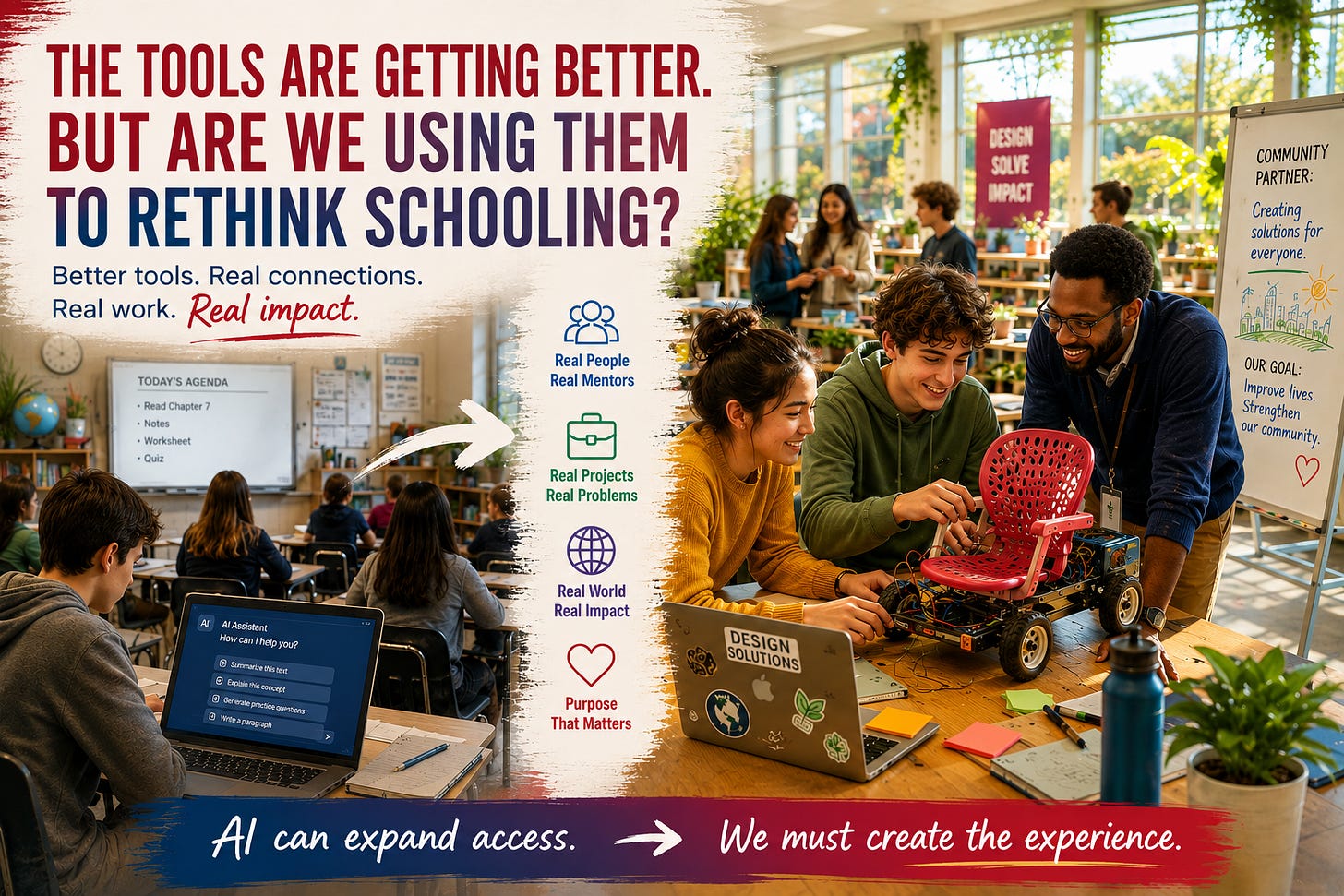
The tools are getting better. But they are still not, in most places, being used to redesign school. AI and AI-powered tools are largely being used to improve the current factory model of schooling: covering content, teaching to old standards, and pressing students through inherited structures — like Lucy and Ethel overwhelmed at the chocolate factory conveyor belt, keeping things moving but not changing anything. What is still too rare is seeing district and school leaders, classroom educators, and invested community members use these tools to truly reimagine schooling and then pursue those new visions in practice. To make that happen, leaders, educators, and communities need time, space, support, and examples for how to use AI not just to ideate, but to plan, build, and pursue new designs for learning.
If that begins to happen, there is real reason for hope. If it does not, then we will have watched AI be used mostly to perpetuate the factory model of schooling, leaving generations of young people behind — not only in what they experience each day, but in what school fails to do: help them explore their interests, develop the competencies they will need, and pursue lives of purpose and possibility.
I hope you will be one of the people who helps change that — and that you find friends, new friends, and fellow revolutionaries to help you imagine and re-imagine the possibilities of schooling. Without AND with AI.
Chris Unger is a Teaching Professor at Northeastern University and co-directs the CPS LEARN Lab. He has been writing about the need for revolution in schooling for a long time, and more recently if AI could contribute to this revolution. If this question is of interest to you and you wish to think together about it, feel free to reach out to me at cunger.neu@gmail.com.