What if the most important outcome of career-connected learning isn’t a career?
Every state has invested in career readiness, work-based learning, internships, apprenticeships or career pathways. That momentum is welcome. Young people deserve opportunities to connect learning to their lives and discover how their strengths can contribute to their communities.
But as career-connected learning expands, there is a risk that success will be measured too narrowly: hours completed, credentials earned and job placements secured. Those outcomes matter. But they tell us little about whether young people are developing the agency, relationships and sense of purpose to navigate a changing world.
The greater opportunity is to help young people discover who they are, build meaningful relationships, contribute to their communities and develop skills they will rely on throughout their lives.
The strongest models begin with self-discovery. Across the Center for Advanced Professional Studies (CAPS) Network, a national network of profession-based learning programs led by co-author Corey Mohn, young people explore their strengths and interests and connect that self-knowledge to authentic projects, mentors and professional experiences. Educators guide the process while learners have room to explore, make choices and pivot.
An internship designed around compliance asks whether a learner completed the required hours. A transformative experience asks different questions:
Did they discover new strengths? … Build relationships that expanded their sense of possibility?
Contribute something meaningful? … Develop a clearer sense of who they are becoming?
Chloe Aspleaf experienced that process firsthand. As a high school learner at Blue Valley CAPS in northeastern Kansas, she was drawn to science and imagined a future in laboratory research. She worked in a professional cancer research lab alongside scientists and Ph.D.s — and discovered she didn’t want to spend her career in a lab. She wanted a more social environment.
Instead of treating that as a failed experience, Chloe used the discovery to inform what came next. She explored health care and began working in a community pharmacy, where she recognized that her strengths fit differently. She ultimately earned a pharmacy technician license while still in high school and pursued pharmacy after graduation.
The deeper value wasn’t simply choosing a career. Chloe had opportunities to test what she was learning about herself in the real world and adjust accordingly.
Discovering what she didn’t want to do was as valuable as discovering what she did.
That is the difference between a career pathway and a learner-centered pathway. It also changes the role of employers. Young people are not simply recipients of opportunities; they can create real value for the organizations around them.
For years, Becky Gripp, who runs The Tamale Kitchen in Kansas City, worked with CAPS learners on challenges her organization genuinely needed help solving. What began as a one-semester project became a partnership that continued every semester for more than five years.
As The Tamale Kitchen grew, learners became collaborators. Graphic design learners developed the wrap for its food truck. Architecture learners planned the placement of equipment inside it. Others researched licensing requirements and developed nutrition labels. Advanced Spanish learners worked alongside employees to set up donated laptops and create email accounts in Spanish.
Gripp brought knowledge of The Tamale Kitchen’s mission and community; young people brought research, technical expertise, ideas and perspectives she didn’t necessarily have herself.
That reciprocity is easy to overlook when career-connected learning is framed primarily as something adults provide to young people. Employers are not simply giving learners a chance. Young people can contribute to work organizations genuinely need. In turn, learners see evidence that their ideas and abilities matter. Communication, collaboration, adaptability and self-direction develop because the work and relationships are real.
For Education Reimagined, where co-author Demi Edwards leads efforts to advance learner-centered education, this dynamic points to an even bigger question:
What if these experiences weren’t additions to school but part of how learning itself was organized?
Learner-centered education starts with the young person — their strengths, interests, relationships and aspirations — and expands where and with whom learning can happen. Schools remain important, but so do workplaces, community organizations, higher education institutions and other places where young people can explore interests, build relationships and contribute.
In Colorado Springs, a community participating in Education Reimagined’s Learner-Centered Ecosystem Lab, that possibility is beginning to take shape. Colorado Springs School of Technology (CSST), a tuition-free public school in District 11’s innovation zone, connects academic learning with experiences across higher education, industry and the community.
Every Monday, learners participate in “sprints” led by professionals from outside the school. They might work alongside a retired engineer in a university lab, learn programming from an entrepreneur at Exponential Impact, a business incubator where CSST is located, or explore how cities can grow while using energy and natural resources more responsibly. Other experiences emerge from learners’ interests, including art and storytelling.
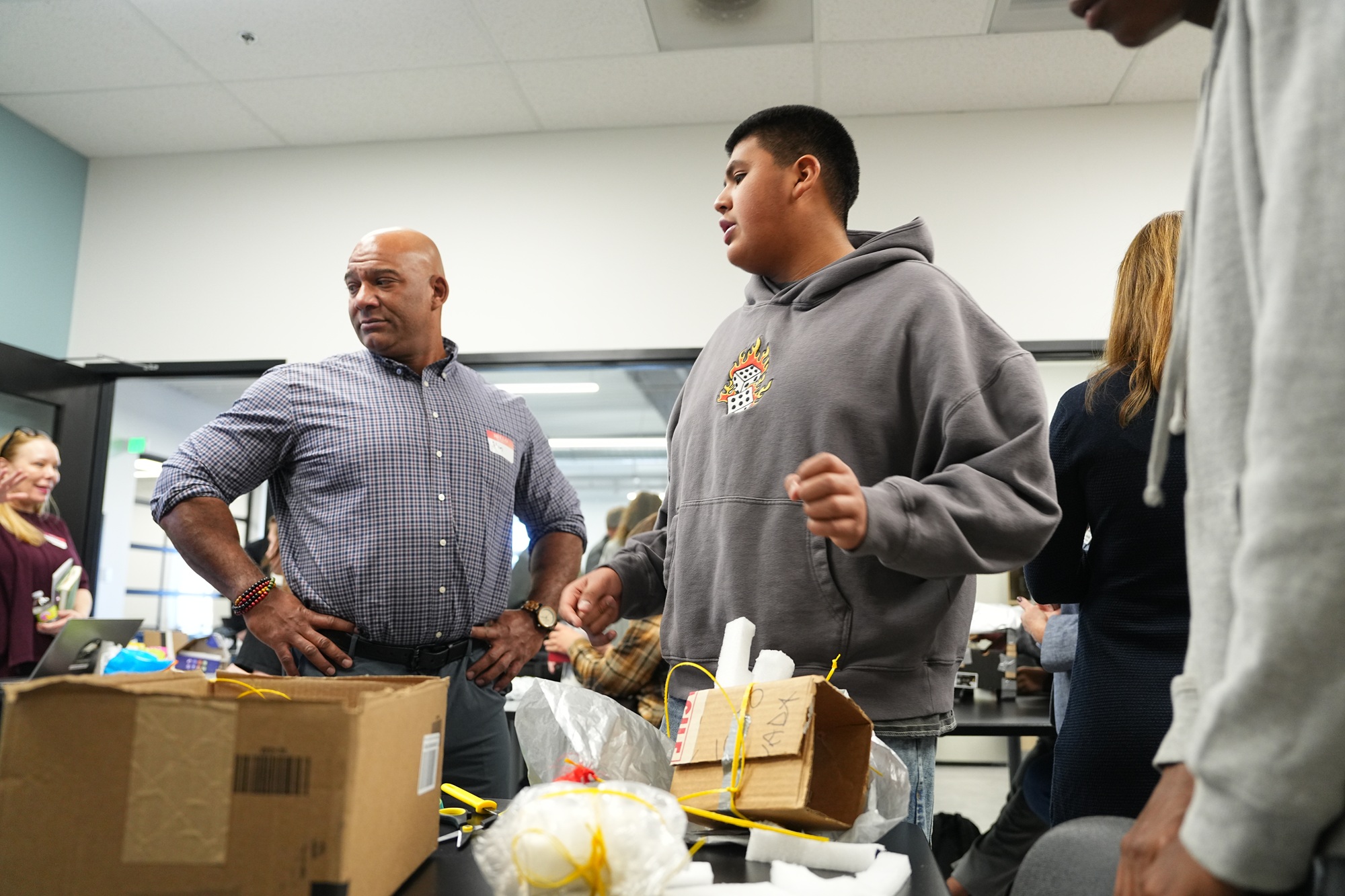
These relationships can open unexpected doors. One learner’s computer skills led to an invitation to participate in a medical-device design project with a professional team at the University of Colorado Anschutz Medical Campus. The opportunity emerged from a young person’s demonstrated abilities and the relationships that made those abilities visible.
The ambition extends beyond one school. Colorado Springs educators and community partners are exploring how learners might access specialized programs across district boundaries, opening opportunities that no single school could provide on its own.
What makes this approach significant is the possibility it creates. A young person discovers an interest, meets someone who recognizes their abilities and gains access to opportunities that might otherwise have remained out of reach. And the school and its partners are deliberately creating the conditions for those connections to happen.
In a learner-centered ecosystem, these aren’t isolated experiences. A workplace can become a field site for learning. A professional can become a mentor. An interest can lead to a project, which can lead to a new relationship or a different direction. The community itself becomes part of the learning environment.
This is the larger opportunity as states expand career-connected learning. Participation, credentials and employment outcomes will continue to matter. But they should be accompanied by a more complete understanding of success: whether young people know themselves, have relationships they can draw upon, understand the value they can contribute and are prepared to navigate constant change.
Career-connected learning is too important to become another compliance exercise.
Its greatest promise is not preparing young people for their first job. It is giving them the relationships and real-world experiences to discover who they are becoming — and the opportunity to contribute now.
Corey Mohn is president and executive director of CAPS Network, empowering high school students to fast-forward into their future through real-world business projects and the development of professional skills. Demi Edwards is CEO and co-founder of Education Reimagined, a national nonprofit driving public education transformation to make learner-centered education a reality for every young person.
The original article published by Youth Today can be found here.